
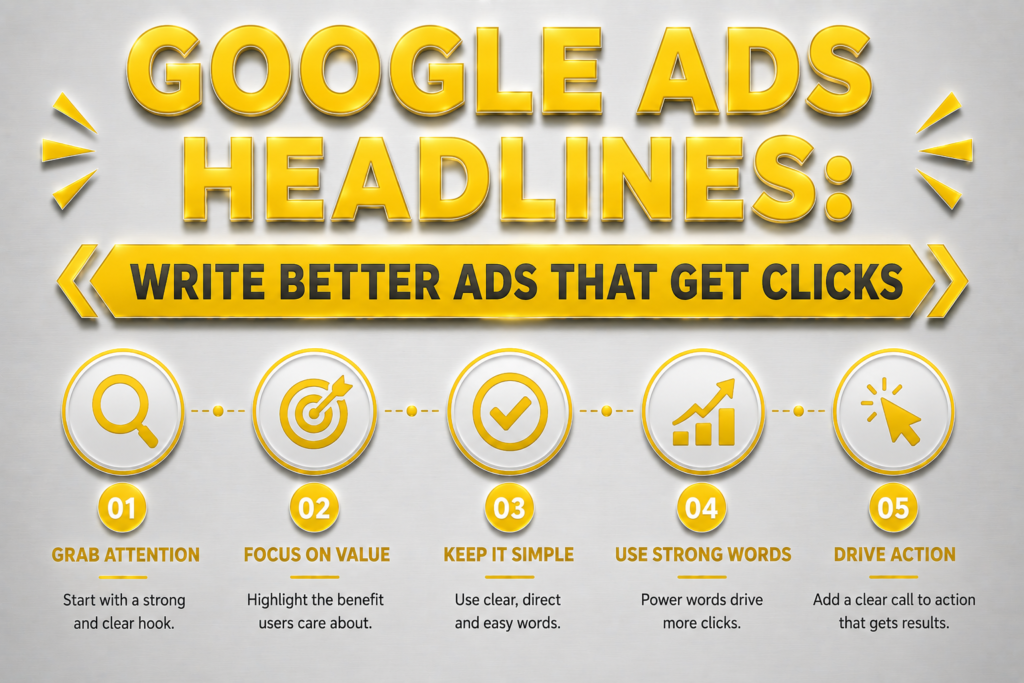
Introduction
Even before they read the description, a powerful Google ad may lose clicks. Why? They have no incentive to care just on the headline.
One of the first things users see when your advertisement shows up in search results is the Google Ads Headline. They must describe what you have to offer, align with what the user was looking for, and provide a convincing argument for moving forward.
This is a common error made by advertisements. They craft clever-sounding headlines that don’t address the needs of searchers. Others employ the same term again without providing the reader with any insightful information. Both strategies may squander important advertising space.
The simpler method is the superior one. Write headlines that highlight the customer’s issue, goal, advantage, and next course of action. Then, rather than presuming that a single headline would appeal to everyone, try many iterations.
This post covers how to write compelling Google advertisements Headlines, how to organize them, what errors to avoid, and how to make your advertisements work better.
A Brief Response
In a nutshell: Google Ads that work Headlines convey a clear advantage, align with search purpose, and entice readers to click. Test several headline combinations, add a helpful benefit, and begin with the primary keyword or client demand. Make sure each headline is understandable, pertinent, and clear.
Why Do Google Ads Headlines Matter So Much?
The Issue
Other search results compete with your advertisement for viewers’ attention. A person could come across many companies selling comparable goods or services.
The user could scroll past your headline if it appears generic.
“Welcome to Our Website” is an example of a headline that tells the reader very nothing. A headline like “Affordable Website Design Services” provides many more helpful details.
Why It Occurs
People quickly skim search results. Before spending time reading the remainder of the advertisement, they want to know if it meets their demands.
As a result, the headline must convey value rapidly. At least one significant query for the reader should be addressed: What is this? Does it apply to me? Why should I click?
The Solution
Understanding the search intent behind the term is the first step in any advertisement. Create headlines centered on that goal.
For instance, headlines mentioning logo design, affordability, quick delivery, or expert branding can be more appealing to someone looking for “affordable logo design”.
Avoid trying to convey everything in a single headline. To convey different aspects of your offer, use distinct headlines.
The outcome
Your advertisement gets more comprehensible. Customers can easily determine that your offer is relevant to their search.
How Do You Write Attention-Grabbing Headlines for Google Ads?
The Issue
Making headlines that are both succinct and compelling is a challenge for many advertisers. They either try to fit a whole sales page into one paragraph or write something that is excessively ambiguous.
Why It Occurs
Because a headline has a limited amount of space, each word must have a purpose. The message is more difficult to grasp when it has more words.
Using complex marketing jargon is not the answer. The goal is to eliminate superfluous words while maintaining the clarity of the essential theme.
The Solution
Make use of this straightforward headline formula:
Keyword + Advantage
For instance:
“SEO Tools for Small Businesses”
An additional helpful formula is:
Issue + Resolution
For instance:
“Having Trouble With SEO? “Get Easy Tools”
Additionally, you can use:
Proposal + Action
For instance:
“Free SEO Audit – Check Your Site”
Because different audiences react differently to different messages, try different strategies.
Typical Errors
Making ambiguous statements like “Best Service Ever”
Adding too many ideas to one headline
The outcome
Your headlines become shorter, clearer, and more relevant to the person searching.
How Should Google Ads Headlines Use Keywords?
The Issue
Some advertisers use the same target keyword in each headline. Some people absolutely steer clear of keywords because they believe that benefits are more important.
Both strategies may lead to issues.
Why It Occurs
Although keywords aid in demonstrating relevance, they are insufficient on their own to convince someone to pick your company.
When someone searches for “online accounting software,” a headline that includes that term can verify its relevancy. However, the benefit—such as straightforward cost monitoring or fast invoicing—should be explained in a different headline.
The Solution
When it makes sense, use the primary keyword. Then convey features, advantages, trust signals, or calls to action using different headlines.
For instance:
- Easy Invoicing for Small Teams using Online Accounting Software
- Keep Track of Spending in One Location
- Get Your Free Trial of Easy Tools for Expanding Companies
- Instead of using the same term again, this provides your advertisement additional meaningful meanings.
The outcome
You may give individuals extra incentive to click on your advertisement while maintaining its relevance.
What Constitutes a Persuasive Google Ads Headline?
The Issue
Even if a headline is pertinent, it may not inspire action. This typically occurs when a clear advantage is not communicated.
Why It Occurs
Features describe the functions of a product. Benefits provide justification for the customer’s concern.
“Cloud Storage With 2TB” is one example of a feature. “Keep Your Files Safe Online” is more customer-focused.
The Solution
After a buyer clicks on your advertisement, consider what they want.
They could wish to:
- Conserve time
- Cut expenses
- Resolve an issue
- Acquire knowledge
- Purchase a product
- Make a service reservation
- Boost outcomes
- Get started fast.
Transform their demands into distinct headline concepts.
Rather than writing “Advanced Marketing Platform,” you might write “Manage Your Marketing in One Place.”
The reader is informed of the platform’s potential benefits in the second edition.
Expert Advice
Write your headlines from the perspective of your target audience. Ask yourself, “What’s in this for me?”
The outcome
Because your headlines emphasize results rather than meaningless marketing jargon, they become more convincing.
How Many Headlines Should You Write for Google Ads?
The Issue
Advertisers sometimes feel that two or three headlines are sufficient. This restricts how many messages they may test.
Why It Occurs
It takes time to write several versions. Making a single headline, copying it into each advertisement, and moving on might seem simpler.
However, experimenting with various messaging can show you what your audience reacts to.
The Solution
Make many headline concepts based on various topics.
For instance, you might write headlines that highlight:
Relevance
“Google Ads Management Services”
Advantage:
“Get More Qualified Leads”
Have faith:
“Experienced PPC Specialists”
Make an offer:
“Free Strategy Consultation”
Take action:
“Book Your Consultation”
Don’t make all of your headlines the same. Give the advertisement a variety of messages that complement one another.
The outcome
You have more opportunity to express your offer effectively and more inventive choices.
How Can Search Intent Be Improved in Google Ads Headlines?
The Issue
Because the messaging doesn’t align with what the searcher truly wants, an advertisement may generate impressions but few clicks.
Why It Occurs
The meanings of keywords might vary. A person looking for “running shoes” could be interested in purchasing them. It’s possible that someone looking for the “best running shoes” is considering their alternatives. The goal of someone looking for “how to clean running shoes” is very different.
The goal of the search must be reflected in the headline.
The Solution
Find out what the user wants before creating the headline.
Pay attention to items, pricing, offers, availability, or purchasing incentives if the goal is transactional.
Concentrate on guidelines, explanations, or helpful resources if the goal is informative.
When applicable, mention the service or place if the intention is local.
By doing this, the advertisement remains relevant to the search.
The outcome
Because it speaks to the initial motivation behind the search, your title seems more pertinent.
How Are Calls to Action Used in Google AdWords Headlines?
The Issue
Certain advertisements describe the deal without instructing the user on what to do next.
Why It Occurs
Advertisers frequently presume that consumers are aware of what comes next. That isn’t always the case.
Uncertainty may be eliminated with a clear call to action.
The Solution
When appropriate, include direct action language in your offer:
- Get Started
- Shop Now
- Reserve Now
- Find Out More
- Request a Quote
- Start Free and Examine Your Options
- Get the Guide here.
Align the landing page with the action. “Book a Consultation” makes sense if your page requests that people schedule a consultation. “Shop Now” would be a better option if your page offers a product for sale.
Avoid promising an activity that isn’t supported by the landing page.
The outcome
After viewing the advertisement, the reader is aware of what to do, which facilitates a more seamless search to conversion process.
How Can Google Ads Headlines Be Tested and Improved?
The Issue
Even visually appealing headlines can have varying effects. Customers might not react most favorably to a message that seems powerful to you.
The Solution
Develop various headline topics and track results.
Try other approaches to:
- Advantages and Offers Keywords
- Features of calls to action
- Signals of trust
Don’t make all the changes at once. Making too many adjustments at once makes it more difficult to determine what factors affected the outcome.
Additionally, confirm that the landing page backs up the headline’s promise. A poor or irrelevant landing page cannot be fixed by a powerful advertisement.
The outcome
Over time, you may enhance your advertising by discovering which messages resonate with your target demographic.
Which Google Ads Headline Errors Should You Steer Clear of?
The Issue
An advertisement may appear less relevant or trustworthy due to minor writing errors.
Why It Occurs
Advertisers sometimes overlook the fact that a real human will see their ads in favor of concentrating too much on keywords.
The Solution
Steer clear of these typical issues:
Keyword stuffing: An advertisement may appear artificial if the same keyword appears in each headline.
Uncertain claims: Avoid making unsupportable promises.
Overuse of punctuation: The advertisement may appear disorganized if there are too many symbols.
Weak advantages: Describe more than just your company. Describe the reasons the client should be concerned.
Inconsistency with the landing page: The offer should be described in both the headline and the landing page.
Generic wording: Words like “Great Service” don’t provide enough information to the reader.
The outcome
Your advertisements appear more genuine, reliable, and helpful.
How Do Landing Page Headlines in Google Ads Operate?
The Issue
If the landing site doesn’t match the title, an advertisement may receive clicks yet still yield subpar results.
Why It Occurs
The landing page and the advertisement are handled differently by several advertisers. They’re not. The landing page must live up to the expectations set by the advertisement.
If your headline is “Free Website Audit,” for instance, the landing page should make that offer clear.
The Solution
Make the link between the title and landing page obvious.
If a discount is highlighted in your headline, display it on the landing page. Make the guide easily accessible if your headline advertizes a free guide.
Throughout the trip, stick to the same fundamental concept.
The outcome
Knowing they’re in the proper location can improve user experience and cut down on unnecessary clicks.
Common Questions
1.Google Ads Headlines: What Are They?
The brief headline components used in Google search ads are known as Google Ads Headlines. They draw attention and aid in explaining the advertiser’s offer. Strong headlines often convey a helpful advantage, align with the search purpose, and provide readers a compelling incentive to click on the advertisement or continue reading.
2.How can I create compelling headlines for Google Ads?
The customer’s search purpose should come first. When it makes sense, utilize the primary keyword; otherwise, use additional headlines to convey features, offers, trust signals, advantages, or calls to action. Make sure your statements align with the landing page and use straightforward language.
3.Do Google Ads headlines need to contain keywords?
Although you shouldn’t use keywords repeatedly, they can assist make an advertisement more relevant to the search. When it makes sense, use the primary keyword organically. To clarify advantages and provide viewers with more incentives to click, employ several headline variants.
4.What is appealing about a Google Ads headline?
A compelling headline is unambiguous, pertinent, precise, and helpful. It should briefly explain to the reader what you have to offer or how you can assist. A headline may be strengthened by including offers, benefits, particular services, and relevant calls to action.
5.Why are there few clicks on my Google Ads yet impressions?
When your offer is unclear, your headlines don’t align with search intent, or your rivals’ messaging is more pertinent, low click-through rates may result. Examine your offer, landing page, headline topics, and keywords. Instead of constantly updating one headline, try out several messages.
6.Should there be a call to action in every headline?
No. Certain headlines can be used for calls to action, while others can be used for relevancy and advantages. By using a variety of messaging, the advertisement avoids making all of the headlines seem the same and provides more helpful information.
Conclusion
Creating successful Google Ads Using smart language is not the goal of headlines. Making the customer’s next choice easy is the goal.
Start with the purpose of the search. Recognize the person’s desires. Next, design headlines that convey a helpful advantage, describe your offer, and direct the reader to the next action.
Don’t depend only on one message. Make a number of versions and experiment with various viewpoints. Make sure your assertions are true, align them with your landing page, and cut out any unnecessary phrases.Generally speaking, the ideal headline is the one that leads the appropriate consumer to say, “That’s exactly what I was looking for.”
Examine your present advertisements first. Replace ambiguous headlines with concise, customer-focused messaging, then track the results.