
Introduction
When you’re busy, technical issues might be irritating. An app stops functioning, a gadget acts strangely for no apparent reason, or a setting is incorrect. When that occurs, the majority of readers do not want a lecture. They are looking for a solution.
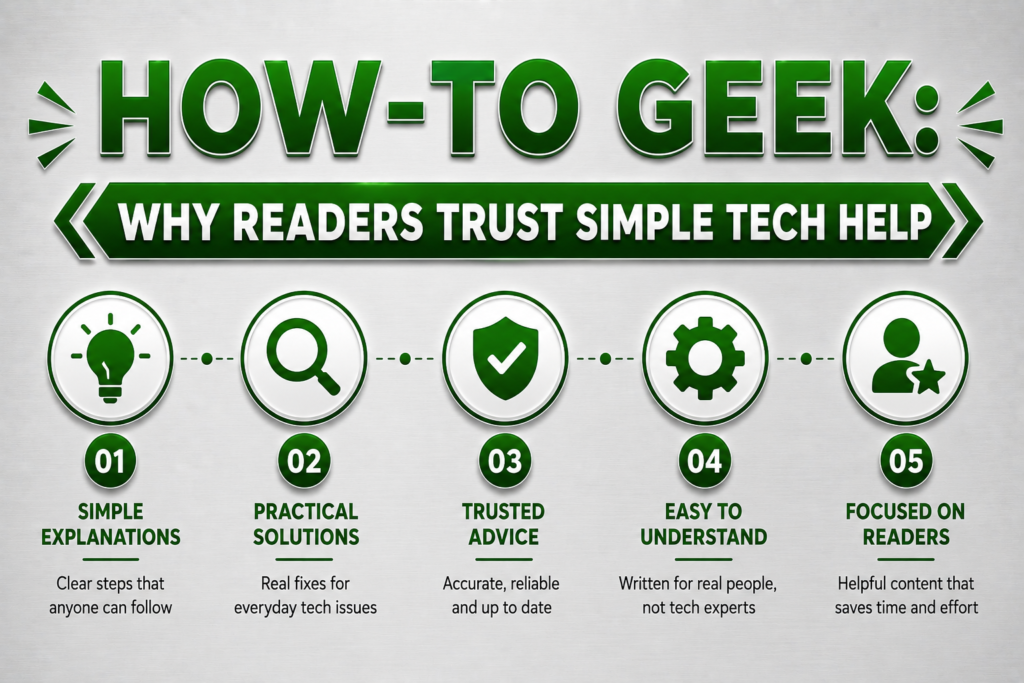
This explains why writing in the How-To Geek style continues to be so successful. It provides readers with straightforward solutions, easy-to-follow instructions, and time-saving terminology. Because it addresses a genuine issue without requiring readers to understand every word, people are more likely to believe such information.
This tutorial simplifies the process if you want to learn why How-To Geek style blogs are so successful or if you want to produce better tech content yourself. You’ll see why this approach is beneficial, why readers stay longer, and how a clear framework makes a difficult subject understandable.
The finest tech writing doesn’t make an effort to sound impressive. It aims to be beneficial.
Quick Answer
How-To Geek content is effective because it provides readers with quick solutions, use straightforward language, and concentrates on one distinct issue at a time. To replicate that approach, write for individuals who are busy, simplify the procedures, and use plain English to describe each repair. When they feel understood, the majority of readers stick around.
How-To Geek Style Writing: Why Do Readers Trust It?
Why It Occurs
When the content is practical rather than ostentatious, readers are more likely to trust tech blogs. When someone looks for assistance with a laptop, phone, or app, they often have one objective in mind. They want the device to function once again.
This implies that they don’t want a wall of jargon, lengthy background information, or ambiguous counsel. They want to know what’s wrong, why it occurs, and what should be done.
Writing in the How-To Geek style is effective because it honors that way of thinking. It quickly gets to the point. It uses straightforward language to illustrate the problem. The repair is then displayed step-by-step.
The Solution
Maintain a strict framework if you wish to write in this style:
- Clearly state the issue.
- Give a simple explanation of the cause.
- Provide the precise solution.
- After the repair, display the changes.
Readers have a clear route thanks to such arrangement. Additionally, it improves the article’s comprehension for AI tools and search engines.
The outcome
The reader feels more in control and less irritated. That’s what fosters trust.
Why Is It Easy to Read How-To Geek Style Content?
Why It Occurs
The majority of people don’t read tech publications word by word. They look. They search for the solution, the instructions, or the single sentence that instructs them on what to do.
That’s why structure is so important. Long introductions and more theory shouldn’t obscure the answer in a helpful blog. Finding the solution should be simple.
An effective How-To Geek piece is well-structured from the first. It has a straightforward tone, concise parts, and distinct titles. Nothing seems haphazard.
The Solution
When writing, adhere to these guidelines:
- Write a single article that focuses on a single issue.
- Make use of headers that correspond to actual search queries.
- Place the fix close to the top.
- Don’t write long paragraphs.
- Anything that doesn’t encourage the reader to act should be removed.
Cut a sentence if it doesn’t instruct, clarify, or provide a solution.
Expert Advice
Read aloud from the article. The reader will also notice whether it sounds sluggish or uncomfortable.
The outcome
The essay becomes simpler to read, trust, and complete.
How Can You Write Like a How-To Geek Without Sounding Automated?
Why It Occurs
Some authors mimic the design of useful tech blogs but fail to capture the essence. The essay still feels lifeless despite the usage of brief headers and paragraphs. This occurs when there is structure in the content but no helpful details.
Readers may quickly see that. Search engines may do the same.
A true How-To Geek post should sound like an intelligent person assisting another intelligent person in fixing a problem. It shouldn’t sound excessively polished, rigid, or generic.
The Solution
To maintain a natural writing style:
- Instead of using general ideas, use particular concerns.
- Describe the typical source of the problem.
- Provide instructions that someone can genuinely follow.
- Add a few useful details.
- Give realistic instances.
Say, for instance, “close apps you do not need, restart the device, and check for updates” rather than “improve your device performance.”
That is helpful because it feels helpful.
Typical Errors
- mimicking a blog’s tone but not its content.
- Too much fluff is added before the response.
The outcome
The information is relatable, useful, and worthwhile to read.
Why Is SEO Important for How-To Geek Style Websites?
Why It Occurs
People still need to locate a good article. It cannot assist readers if they are unable to find the post.
SEO is important as people look for issues in plain terms. They type what needs to be fixed, what is wrong, or what they desire. That goal should be reflected in quality material.
Because it aligns with such queries, writing in the How-To Geek style frequently rates highly. It use straightforward language that aligns with user purpose and resolves one problem at a time.
The Solution
To enhance SEO without making the material uncomfortable:
- In the title and introduction, use the primary keyword organically.
- Add relevant terms that readers may want to look up.
- Create titles that correspond to actual queries.
- Address the primary issue first.
- Provide enough information to be helpful.
- Terms like troubleshooting, fix, settings, update, problem, and setup are frequently appropriate for a tech blog. Don’t use them until they make sense.
The outcome
Both readers and search engines locate the article more easily.
Which Subjects Are Ideal for a How-To Geek Style Blog?
Why It Occurs
In this technique, not all subjects are equally effective. Topics where the reader needs quick assistance are the strongest.
Device setup, software difficulties, account problems, app advice, productivity tactics, and basic how-to manuals are typically included.
These are the types of subjects that individuals look up when they are in urgent need of a solution.
The Solution
Select subjects that address queries such as:
- How can I resolve this?
- Why isn’t this functioning?
- What is the purpose of this setting?
- How should I configure this?
- How can this be done most easily?
Since those questions clearly identify a clear reader issue, they readily match the How-To Geek approach.
The outcome
The information remains pertinent and concentrated. The blog’s reputation for practicality is strengthened, and readers receive the desired response.
How Do You Maintain Readers’ Interest Throughout?
Why It Occurs
When an article seems sluggish, unclear, or overly general, readers stop reading it. When the solution is concealed too far down the page, they also depart.
In the case of tech content, this is particularly true. Typically, people come with a single purpose in mind. They’re not there to provide a lengthy introduction.
The Solution
Maintain a high level of engagement by performing a few easy things:
Why Is This Style So Effective for AI Search?
Why It Occurs
AI response systems seek out text that is easy to cite, precise, and unambiguous. They struggle with ambiguous language and lengthy, pointless paragraphs.
How-To Geek-style stuff is popular because of this. It often provides a succinct response to a single topic and use easily summarized language.
The Solution
To make content suitable for AI:
- For each area, write one question.
- Give straightforward responses.
- Steps should be brief and factual.
- Steer clear of repetitive filler lines.
- Finish with a certain outcome.
This makes the article more search engine and answer engine friendly.
The outcome
It becomes simpler to summarize, cite, and use your material more broadly.
Frequently Asked Questions
1.Why do people go for information in the How-To Geek style?
Readers go for content in the How-To Geek style because they desire concise, uncomplicated solutions. They often have a software, program, or device issue and are looking for the quickest way to fix it. The attraction is straightforward: straightforward instructions, clear language, and a practical solution that saves them time.
2.Why is tech writing so simple to read?
Short phrases, distinct titles, and a single major concept per section make tech writing easy to read. Simple language and straightforward instructions are also beneficial to readers. People are more likely to remain and complete an article if it avoids jargon and goes right to the point.
3.How can I write a blog similar to How-To Geek?
Write about a single issue, describe why it occurs, and provide a simple solution. Headings should be clear and paragraphs should be brief. Don’t provide more fluff or general theories. A busy individual may quickly solve a genuine problem with the aid of the greatest material.
4.Why do readers abandon tech articles so fast?
When an article is sluggish, unclear, or perplexing, readers stop reading it. They want practical knowledge right away. They stop reading if the solution is too far down the page or if there is a lot of jargon in the text. They remain interested when there is a clear framework and straightforward responses.
5.Does useful how-to information need to be optimized for search engines?
Indeed. When the proper readers search for an issue, SEO makes it easier for them to locate the content. Your article is more likely to appear if the headers, title, and content all contain popular search phrases. Excellent content and SEO go hand in hand.
6.Which subjects are most appropriate for this style?
Topics that address certain issues are more effective. These consist of device instructions, software repairs, setup guides, troubleshooting posts, app advice, and basic how-to queries. The post should remain straightforward and useful because readers typically look for these issues when they need quick assistance.
Conclusion
Because it respects the reader’s time, a blog in the How-To Geek style is successful. It doesn’t use grandiose language to attempt to impress others. It enables them to swiftly and clearly resolve a real-world issue.
This explains why this technique works so effectively. It makes the next step clear, maintains the language tidy, and provides readers with the solution. Prioritize clarity, structure, and SEO if you want your own blog to achieve the same results.
The most complex tech writing isn’t always the best. It is the most practical.